
The Serotinous Problem:
On AI, Sustainability, and the Tensions Worth Keeping

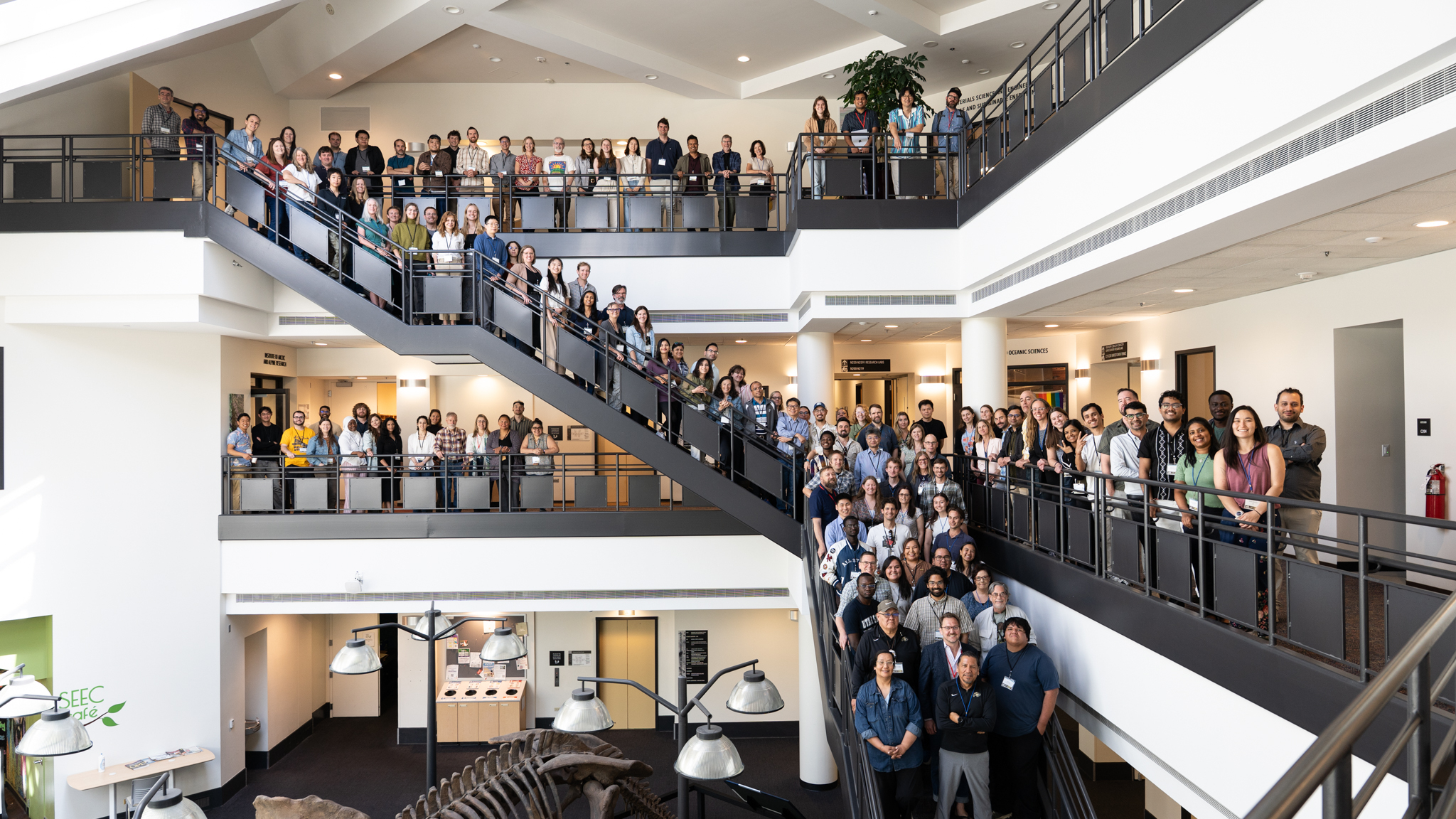
Participants of the fourth annual ESIIL AI for Sustainability Summit, University of Colorado Boulder, May 12–14, 2026. Photo: Lauren Lipuma, CIRES
I was hiking toward the Flatirons the morning after the AI for Sustainability Summit ended, Brené Brown’s Strong Ground in my earbuds, when a pattern from the past three days finally had a name. All week I had felt the pull of the tap-out. Brown describes it in the book: when two opposing ideas are both valid and the tension becomes uncomfortable, we tend to pick the familiar one and quietly discount the other. We call something bad, or we decide it is fine, and we move on. The paradox, she writes, is tenacious. We are the ones who give up on it.
The AI for Sustainability Summit, hosted by the Environmental Data Science Innovation and Impact Lab (ESIIL) at the University of Colorado Boulder, brought together more than 100 researchers, practitioners, and early-career scientists around that exact refusal to tap out. ESIIL’s director, Dr. Jennifer Balch, whom I met at last year’s summit, opened by naming the tensions the summit was designed to hold, not smooth over:

Sequoia seed cone brought by Dr. Balch and passed around the room. We all could feel the wax coat, the serotinous strategy that this species uses.
- AI for sustainability is not sustainable AI.
- The slow build of relationships may not be what the rapid pace of data requires.
- Traditional ecological knowledge and Eurocentric science do not simply fuse.
- Practical solutions and science innovation pull in different directions.
- Sustainability is a long game, but the need for solutions is now.
Then she passed a small sequoia cone around the room. Serotinous, she explained: sealed by a resin coat until fire arrives, opening only under heat intense enough to threaten the tree itself, releasing its seeds into the ash. She asked the room what that had to do with intelligence.
The Boundary
The boundary between what AI can do and what it cannot at this moment in time kept surfacing across the summit’s sixteen working groups, and rarely where people expected it. A causal inference workshop1 drew a sharp distinction between two fundamentally different epistemological tasks: AI optimizes for predictive ability, maximizing what a model can anticipate; causal inference explicitly maps and accounts for every connection, asking not what will happen but why. Katherine Siegel, who led the workshop, put it plainly: AI often facilitates thinking less critically about what we are doing, a concern also raised in this Nature comment article. And yet the two approaches can have synergistic effects when used together. Causal inference is data hungry, requiring large samples, time series, and dozens of variables, and AI can assemble, harmonize, and fill those data layers in ways that would otherwise be intractable. AI, in turn, benefits from causal structure that keeps it from optimizing confidently in the wrong direction. Using both is not a compromise. It can offer a more rigorous approach than either alone.
An Earth embeddings presentation2 showed that a single shared computational step can compress petabytes of satellite data into representations useful for dozens of downstream tasks, runnable on a laptop, accessible without a GPU cluster. An AI workflow demonstration3 showed that a moderately sized language model, given a clear structure and the right tools, could write code, diagnose errors, and log its actions for a geospatial data harmonization task in minutes, a task that would require days otherwise.
Participants divided themselves into sixteen groups around topics they selected and refined, and tested these boundaries across an extraordinary range of questions. One built an AI-powered pipeline for mapping mining claims and water impacts in the Black Hills of South Dakota, and designed the entire system to run offline on sovereign data centers, with no external model at runtime: AI capability and data sovereignty held together by design rather than traded off against each other. Another proposed building an LLM specifically to help communities make ethical decisions about using LLMs, an AI whose purpose is to slow down the uncritical adoption of AI. Both groups were, in their own way, refusing the tap-out.
The range of questions the summit surfaced extends well beyond Boulder. Within SETx-UIFL, researchers have been applying generative AI to land cover forecasting to anticipate where development is likely to spread, and machine learning to assess bacteria levels in the Neches River after flood events. In a region where disaster preparedness and post-disaster response determine how communities endure and recover, that boundary is worth finding.
The Named Elephant in the Room
The hardest tension in the room was also the most named. Using AI is consuming resources at a scale that is difficult to fully account for, and it is also a genuinely powerful tool for understanding environmental systems under pressure. Every session surfaced some version of that tension. The temptation each time was to resolve it, to land on a verdict, to label the technology and move on. What the summit kept asking, and what Brown’s framework made legible on the trail, was whether I could hold the uncomfortable truth instead: that responsible use means staying conscious of the resources spent, reporting them honestly, and doing the work well, all at once, without letting any one of those obligations cancel the others.
The cost of that tension is real and largely invisible. A white paper from the COMPASS Research Consortium at the University of Texas at Austin projects that data centers could account for between 3 and 9 percent of Texas’s total water use by 2040, approaching the scale of major industrial sectors. The communities closest to those facilities bear that cost without necessarily benefiting from the computation it enables. Ty Tuff and colleagues pointed us to this quick visualizer4 that translates basic AI usage into familiar, human-scale energy terms anyone can relate to. Understanding the cost personally is one thing; embedding it in the scientific record is another. A working group at the summit conducted a structured literature review of environmental data science publications confirming that energy consumption is almost never reported alongside standard performance metrics like R-squared, and building the case that it should be. Making the cost visible does not resolve the tension. It is the minimum condition for not tapping out of it.
In my working group we tested large language models on thousands of wildfire-related tweets that had been curated, classified, and analyzed by human scientists over several months, providing a ground truth baseline. The best-performing model, with a provided elaborated workflow, reached in a matter of minutes a 63 percent accuracy on sentiment analysis, consistently flattening ambiguous or distressed content into a neutral category. It also induced qualitative themes that diverged meaningfully from those the human analysts had identified, grouping things that did not belong together and missing categories that mattered. Capable and limited at the same time. Both things are true. In crisis communication, the categories a model misses are not neutral omissions. They are areas where community needs and institutional response can fail to connect, and this can have human consequences.
What Humans Bring
What models miss, it turns out, is often what humans can bring. Phil Two Eagle opened the gathering with a Lakota prayer and the seven-generation teaching, grounding every technical decision made that week in a question the models cannot answer: what should the science be optimizing for, and for whom, across seven generations? Elisha Yellow Thunder, a Lakota PhD candidate building a data sovereignty framework for remote sensing on the Pine Ridge Indian Reservation, closed it by asking who bears the cost of the data centers that make all this computation possible, and reminding the room that relation comes before the tool. “Ask your grandmother before you ask AI.” The facilitation team from Divergent Science LLC held the three days together around a single insight: what determines whether a team does good work is not who is on it but how its members work together, and the most generative ideas tend to emerge only after the group has stayed in discomfort long enough to stop reaching for the obvious answer. Brown would recognize the structure: the groan zone is just another name for refusing to tap out until new ideas converge and facilitate a better understanding of the divergent but true ideas.
The serotinous problem is not whether AI can be useful for environmental science. It can. The harder question is whether the field can build intelligence that is shaped by the crisis rather than merely aimed at it. Tools whose design logic starts from the constraints: the energy cost, the data sovereignty, the causal structure, the communities closest to the harm. The summit was circling that question all week without always naming it that way. I came down from the Flatirons without an answer to it. What I came down with was something more durable: a clearer sense of who is doing this work, how seriously they are taking the full weight of it, and what it looks like to stay conscious of the resources, report them honestly, do the work well, and hold all three obligations at the same time. The serotinous cone does not resolve the fire. It just knows what to do with the heat.
1 AI for causal inference. Led by: Katherine Siegel, Timothy Ohlert, and Brian Lee.
2 Earth Embeddings: Harnessing the Information in Earth Observation Data with Machine Learning. Speaker: Esther Rolf, Assistant Professor, University of Colorado Boulder.
3 LLMs for robust application in environmental sciences. Led by: Cassie Buhler and Ty Tuff.
4 Jon Ippolito, “What Uses More,” Learning With AI, What-Uses-More.com, launched 25 June 2025.